Most Americans Saw Fauci as the Voice Against Reopening Schools, Surveys Find
Three national surveys reveal a striking gap between what Dr. Anthony Fauci says he intended and what the public actually heard about pandemic school closures.
By Brainova
The Perception Gap
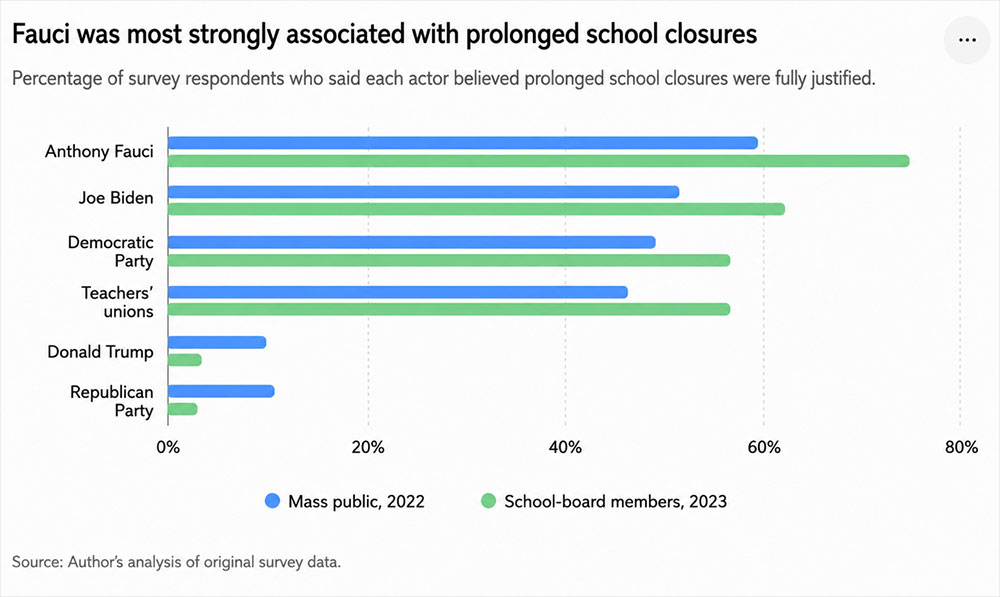
Dr. Anthony Fauci has maintained since August 2020 that he pushed to reopen schools in areas with low infection rates. "Close the bars, open the schools," he told CBS News four years later, summarizing his stance. Yet three national surveys conducted between 2022 and 2025 suggest his message never landed. In a November 2022 YouGov Cooperative Election Study panel of 1,000 U.S. adults, weighted to represent the national population, 57 percent of respondents said they believed Fauci thought keeping schools closed throughout the 2020-21 school year was strongly justified. That figure surpassed every other leader or organization respondents were asked about, including presidents Biden and Trump, both major parties, and teachers unions.
School Board Members Heard the Same Thing
A December 2023 survey of 5,000 elected school board members, weighted to reflect the demographic characteristics of districts nationwide, showed an even sharper perception gap. More than seven in 10 board members said they believed Fauci viewed prolonged closures as strongly justified. These were the officials making reopening decisions in their own communities. The finding suggests that the people most directly responsible for getting children back into classrooms operated under the assumption that the nation's most prominent public health official supported keeping them out.
A Shared Misreading Across Party Lines
The belief that Fauci backed extended closures cut across partisan divisions. Among Democratic respondents in the 2022 survey, 63 percent said they thought Fauci considered prolonged shutdowns strongly justified. Among Republicans, 57 percent held the same view. The gap between the two was narrow enough to suggest this was not a talking point that originated on one side of the aisle. Both coalitions had absorbed a similar reading of Fauci's public posture, regardless of what he now says he meant to convey.
Perception Shaped Risk Assessment
Respondents who believed Fauci supported school closures assessed reopening risk very differently from those who thought he opposed them. In the 2022 survey, participants were asked how risky it was for a 10-year-old child or a 50-year-old teacher to return to elementary school. Those who saw Fauci as a closure advocate were roughly twice as likely to say school remained too risky for students, and about 40 percent more likely to say a vaccinated teacher still faced substantial danger. The survey cannot establish causation — Americans who already feared reopening may have projected that stance onto Fauci — but it demonstrates how tightly his public image had fused with continued anxiety about classroom safety, even after vaccines became widely available.
Fauci's Perceived Stance Moved Opinion More Than Evidence
A 2025 YouGov survey tested whether evidence or authority mattered more when Americans judged prolonged closures. Respondents were reminded that many schools stayed shut after vaccines arrived while bars and restaurants reopened, then split into four groups. One received no additional information. The others learned that research showed closures caused lasting academic harm, that Trump had opposed extended shutdowns, or that Fauci himself had publicly rejected them. Roughly two-thirds of Republicans called the policy wrong regardless of what they were told. Among Democrats, a third of those given only the baseline facts said closures had been wrong. Learning loss research barely moved that number. But when Democrats learned Fauci had rejected year-long shutdowns, nearly half concluded the policy had been wrong. Fauci's perceived position carried more persuasive force than data on what closures did to children.
What the Intended Message Became
Fauci may be correct about what he meant to say. His August 2020 remarks to National Geographic urged districts in low-infection areas to "try very hard to get the children back to school." But intent and reception diverged sharply. Across three surveys spanning adults, school board members, and a controlled experiment, the consistent finding is that most Americans — including those making reopening decisions — heard something else entirely. Fauci's public standing became a proxy for judging whether classrooms were safe, shaping both individual risk assessments and collective policy judgments long after the epidemiological calculus had shifted.