Stop Memorizing AWS Security Tools: A Learning Path That Starts Where Attacks Actually Begin
The most effective way to learn AWS security isn't by listing GuardDuty and WAF features—it's by understanding the exposed access keys and open SSH ports that cause real breaches.
By Brainova
The Toolbox Trap
The common approach to AWS security education is backwards. Learners jump straight to GuardDuty, then WAF, then Security Hub—collecting service names as if the list itself will create understanding. It resembles opening a mechanic's toolbox and memorizing every wrench without knowing how an engine works. In a real AWS environment, the problem never starts with "which service do I know?" It begins with something more practical: a developer leaving an access key inside application code, a security group exposing port 22 to the internet, logging disabled, or an IAM role granted far more access than it needs. Before choosing a security service, you need to understand what is exposed, what an attacker could reach, and how much damage they could cause. That means starting with IAM and VPCs. IAM teaches who can access an account and what they are allowed to do. A VPC shows how applications, servers, and network traffic connect. Once you deploy a small application and review its weak points, tools like GuardDuty, Config, WAF, Inspector, and Security Hub stop feeling like a random list—each one gains a clear job.
Starting with IAM and VPCs: The Foundation That Makes Services Make Sense
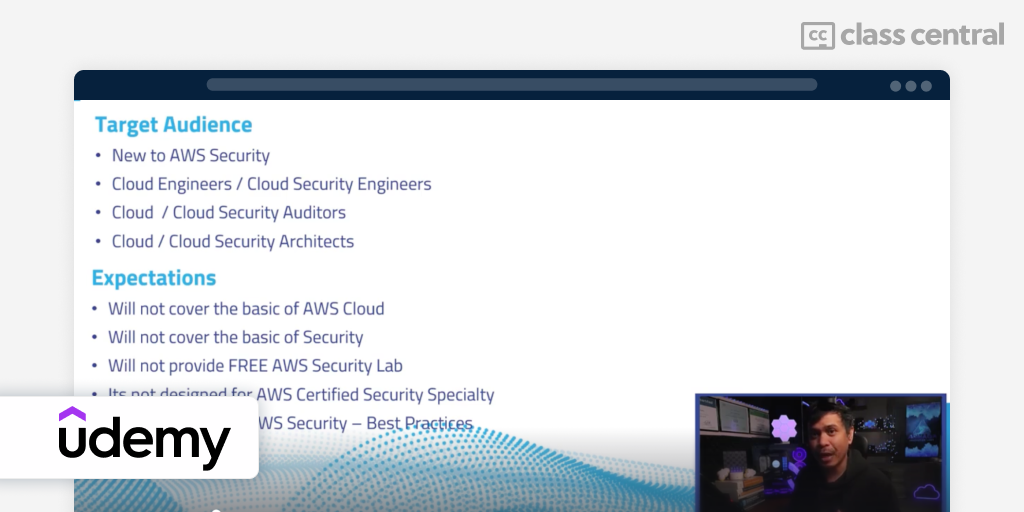
Dean Armada's AWS Security Best Practices course takes a foundation-first approach. It demonstrates how security services work together by following a compromised access key example: CloudTrail provides activity history, GuardDuty identifies suspicious behavior, and Detective supports the investigation, with Security Hub and Config adding context. The network section similarly clarifies security groups, NACLs, WAF, and Shield by showing where each control operates. The course expects familiarity with EC2, S3, IAM, and VPC basics. It covers the shared responsibility model, IAM policies, roles, temporary credentials through STS, permission boundaries, and access analysis. It also addresses visibility through CloudTrail, CloudWatch, Config, GuardDuty, Security Hub, and Detective, and data protection via KMS, CloudHSM, and Secrets Manager. The intended audience is cloud engineers, DevOps practitioners, and security professionals who already understand AWS basics.
From Exposed Ports to Incident Response: Oak Academy's Guided Approach
Oak Academy's AWS Security Management & AWS Security Specialist Course frames security around decisions engineers and analysts face daily rather than presenting each service as an isolated topic. The guided format suits learners with basic cloud concepts who need help seeing where controls fit. A key example examines an overly permissive security group: closing an exposed SSH or RDP port is only the immediate fix, and the course pushes further by asking who changed the rule, when it happened, and whether the instance received suspicious traffic while exposed. It ties that investigation to CloudTrail, Config, GuardDuty, and other monitoring data. Other modules cover IAM, network protection, encryption, and logging, each connected to a simple security purpose: limiting access, reducing exposure, protecting stored information, or preserving evidence. This is a guided introduction across several security areas, not specialist training; learners needing advanced detection engineering will require additional training afterward.
The Generalist's Entry Point: AWS Cloud Practitioner Essentials
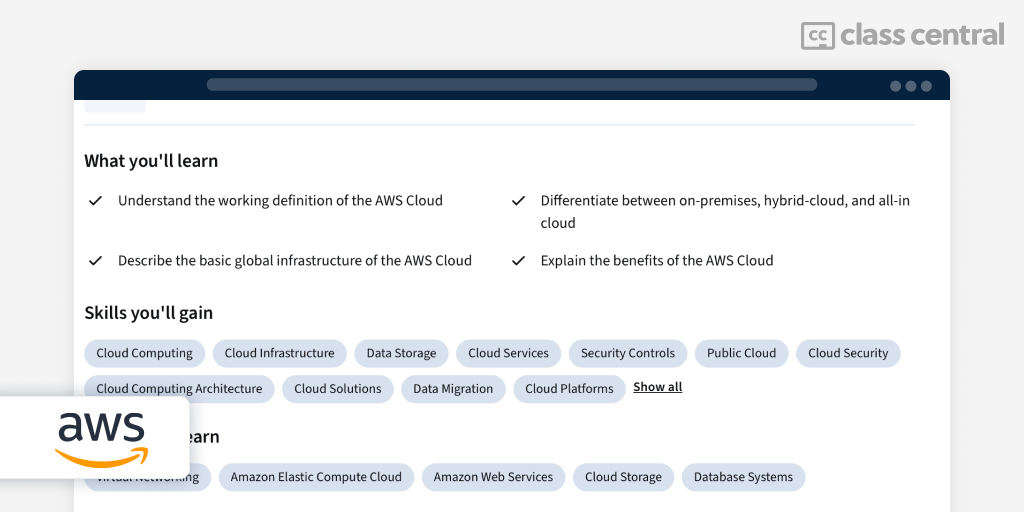
For someone completely new to AWS, jumping into dedicated security training may be premature. AWS Cloud Practitioner Essentials is a general AWS course, not dedicated security training. It first explains how AWS is organized and introduces main computing, storage, database, and networking services before security topics appear within that broader context. The shared responsibility model is one of the more useful parts for an aspiring security analyst: AWS secures the physical infrastructure behind S3, but it does not decide who can access a customer's bucket or whether its contents require encryption. If that bucket is exposed publicly, the problem is usually the customer's permissions or governance, not the underlying infrastructure. The course covers Regions, Availability Zones, edge locations, EC2, S3, EBS, EFS, RDS, DynamoDB, and Elastic Load Balancing, as well as IAM fundamentals, access control, compliance, CloudWatch, CloudTrail, Trusted Advisor, pricing models, and billing. Once these basics are in place, dedicated security training becomes more digestible.
Securing the Pipeline Before Deployment: The DevSecOps Path
Most AWS security courses begin after an application has already been deployed. AWS Security: DevSecOps & AWS Security Services & Terraform starts earlier—with source code and the delivery pipeline. The course involves setting up an environment, connecting source control, and building a deliberately vulnerable application pipeline before adding security checks. Those checks are introduced at distinct stages: SonarCloud and Snyk run alongside secret and dependency scanning, while OWASP ZAP tests the running application. Findings can be sent to Jira, assigned for remediation, and verified again before the pipeline continues. Following one application through this process makes the material easier to understand than separate demonstrations of unrelated tools. The focus later shifts to post-deployment security: Inspector, GuardDuty, Security Hub, and Macie cover different parts of AWS workload monitoring, with Terraform managing the underlying infrastructure. The course spans the delivery process, and the tradeoff is breadth—someone seeking only detailed Terraform training will cover more material than necessary.
SCS-C03 Preparation: Zeal Vora's Comprehensive 46-Hour Deep Dive
AWS Certified Security Specialty 2026 is a 46-hour self-paced course built for detailed SCS-C03 preparation. It covers detecting attacks, protecting AWS infrastructure, and implementing security in enterprise environments. The course builds IAM knowledge covering policies, roles, permission boundaries, resource policies, federation, and cross-account access. It addresses infrastructure protection through VPC design, security groups, NACLs, endpoint controls, and edge protection, plus data protection via KMS, Secrets Manager, S3 controls, database security, and certificate management. Detection and response uses CloudTrail, CloudWatch, Config, GuardDuty, Detective, Inspector, Security Hub, and Macie. The material also covers multi-account governance, compliance, and audit readiness. The volume of material may be a drawback—one reviewer found both the course and its practice tests unnecessarily long. It is unlikely to suit someone seeking brief revision shortly before the exam.