Three Circles and a Ruler: The Character Turnaround Method That Fixes Proportion Drift
Gerardo Escamilla's turnaround technique uses three freehand circles on a ruled page to align a character's features across front, side, and over-the-shoulder views, then refines them with graphite, ink, and tonal markers.
By Brainova
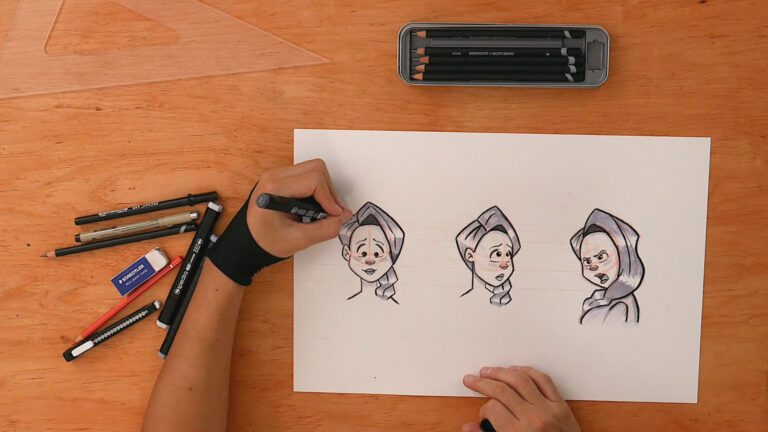
Front View: A Centerline and a Readable Silhouette
The first circle becomes the frontal view. Escamilla draws a vertical line down its middle, splitting the face into symmetrical halves. On top of the circle he develops the character's head and expression, keeping the design readable and easy to understand. That means avoiding cluttered detail and making sure the silhouette of the face works even before the features are added. The centerline acts as an anchor for the nose, mouth, and chin, and it will carry weight into the next view. The features are placed in relation to the circle's edges: the top of the head comes close to the circle's rim, while the jaw drops just below the bottom curve. This makes the circle a proportion cage rather than a strict boundary. The front view is the one where the character's personality and baseline proportions are fixed; every subsequent view has to answer to it. Escamilla keeps the design simple enough that a viewer can read the face at a glance, which also makes later alignment checks easier.
The Over-the-Shoulder Third Pose
The third circle breaks the pattern. Escamilla draws the character in a more complex pose, looking over her shoulder. This view tests whether the proportions from the earlier circles survive a change in head position and neck rotation. He keeps an eye on the previous drawings for reference, checking that the features still align even as the angle skews. The over-the-shoulder glance requires adjusting the centerline and shifting the features along the curve of the head, and it's the step that most often reveals a mistake made in the first two views. If the ears sit too high or the jaw drifts, it shows up here. This is where the ruler work pays off—the original lines give a baseline to return to when the pose gets complex. The circle itself is no longer symmetrical; the chin moves off the vertical axis, and the far eye becomes smaller and higher on the face. Escamilla treats the third circle as the proof of the system: if the freehand circle and ruler lines hold up through a pose that twists the head, the turnaround is working.
Graphite Corrections, Ink Finals, and Tonal Depth
Once the drawings feel right, Escamilla switches from colored pencil to graphite. He goes over the lines with a graphite pencil, correcting any mistakes that the looser colored-pencil pass left behind. This is a refining stage, not a redraw—he keeps the successful shapes and tightens the wobble. After the graphite pass, he brings in the black liner to make the final marks permanent, tracing over the pencil work. Then the tonal markers add shadows and dimension, giving each view a sense of volume rather than flat outline. The markers are layered in gradient strokes, darker where the head turns away from light. The result is a three-view turnaround that reads as one coherent character, even though each circle was drawn and adjusted separately. The eraser's role is here: it lifts the colored pencil marks that are no longer needed, leaving only the ink and marker. That separation of layers—colored base, graphite correction, ink final, marker shading—keeps the process reversible until the last step.