AI Slop Is Flooding Teachers Pay Teachers. YouTube Coaches Want You to Join In.
The marketplace promises peer-made classroom resources, but machine-generated content riddled with errors is proliferating—and the platform's parent company insists it's a 'minuscule fraction' of sales.
By Brainova
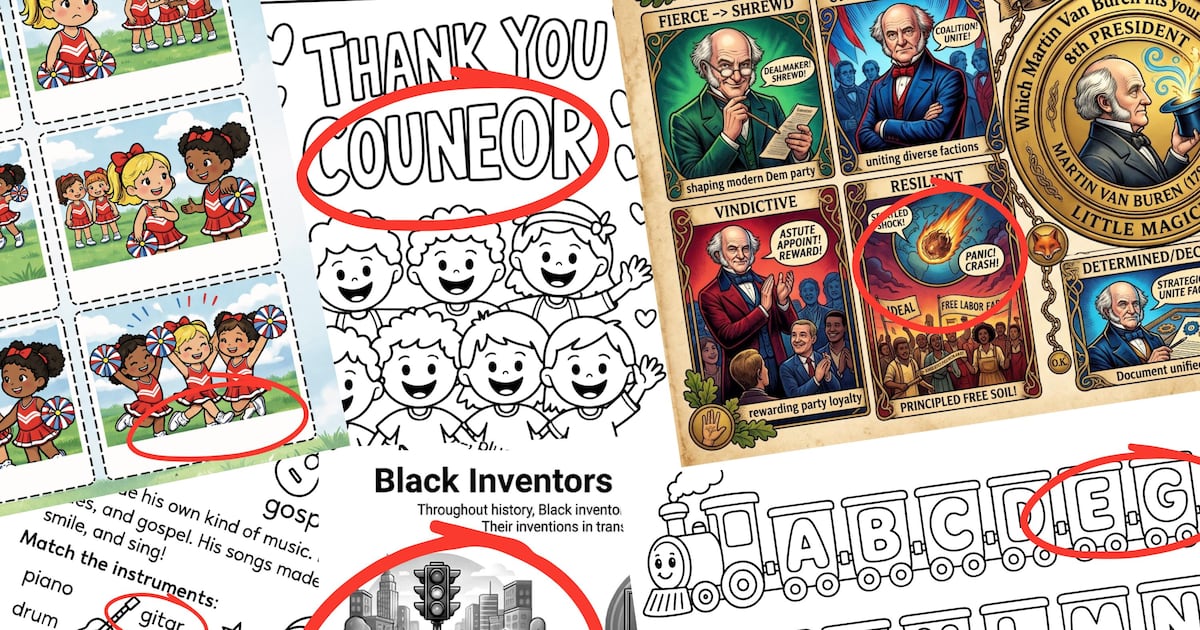
A Black-inventor poster swapped potato chips for a gas-masked firefighter
A $4 poster meant to celebrate George Crum's most famous contribution—the potato chip—instead shows a firefighter in an ominous gas mask standing beside a stop light. The caption beneath Crum's name contains the garbled phrase "when a customer is polated thinner fried potatees." The seller, Jade Désautels of The Garden of Art, said she spent fifteen years as a full-time teacher before launching her shop and now uses "a variety of digital tools" in her creative process, declining to say directly whether AI was involved. Chalkbeat found the resource still listed with visible errors after publication inquiries were made. TPT is used by 85 percent of U.S. pre-K through 12th-grade educators, according to a 2023 IXL Learning press release, meaning even a single flawed listing can reach a vast audience. Education professor Catharyn Shelton of Northern Arizona University said that when teacher-to-teacher sharing scales into a marketplace, creators face pressure to build shops with thousands of pages, and quality becomes expendable. For shoppers scanning similar listings, the red flags here are concrete: an image that has no logical connection to the subject it claims to illustrate, and text so garbled it could not have survived a single human read-through.
An alphabet worksheet skipped the letter F entirely—and still costs $1.99
A coloring worksheet designed to teach young children the alphabet jumps straight from E to G. The missing F means the page fails its own stated purpose. Listed at $1.99, the resource is one of several low-effort products that education professor Catharyn Shelton of Northern Arizona University says reflect marketplace incentives gone wrong: when creators are pushed to build shops with thousands of pages, quality becomes expendable. AI tools make it trivially easy to bulk-generate worksheets, but automated output rarely catches a missing letter the way a proofreading human would. The site's marketplace rewards sellers who produce at volume, incentivizing rapid generation over careful review. For anyone downloading similar materials, the fix is simple but requires effort that the low price point discourages: check every page of a resource before handing it to students.
TPT's parent company says AI products are a "minuscule fraction" of sales
Paul Mishkin, CEO of IXL Learning, which acquired TPT, wrote that the platform relies on "algorithmic tools to identify and demote stores associated with low-quality, AI-generated content." He added that such products "account for a minuscule fraction of a percent of TPT's sales." The claim is difficult to verify independently. What is measurable is the material still sitting on the site: a Black-inventor poster with a gas-masked firefighter instead of potato chips, a presidents poster using an asteroid to represent resilience, an alphabet worksheet missing the letter F, and a set of musical-instrument posters still carrying leftover AI generation prompts—all listed for sale, all with visible errors. TPT rebranded in 2022, and CEO Mishkin has positioned the company's algorithmic response as "highly effective." The gap between those assurances and the products a reporter can still find with a simple search suggests that whatever filtering exists is not catching everything, or is catching it too slowly.
Musical-instrument posters contain AI prompt text the designer never removed
A set of posters on musical instruments in Black history, priced at $4.28, includes a traditional African drum paired with the instruction "add a performer playing it in a lively village setting." No performer or village appears—because the line is a leftover generation prompt. A reviewer called the posters "poorly made" and "very obvious that AI was used." The creator, Achraf Zenmrouni, told Chalkbeat he uses "AI-assisted tools as part of my design and creative process" and reviews material before it goes live. The prompt artifact suggests otherwise. The error reveals a specific workflow: a creator types a description into an image generator, receives output, and publishes without carefully reading every element. When a seller manages hundreds of listings, that kind of oversight multiplies. TPT's marketplace rewards shops that produce at volume, pushing sellers toward speed over careful review. For buyers, the red flag is unmistakable: if a published resource reads like a set of instructions rather than finished educational material, the creator likely pasted in AI output without a final proofread.
Teachers under time pressure rarely vet what they buy
Jeff Carpenter, an education professor at Elon University, said educators are "drowning under the load of expectations" and often lack the time to assess resources they download. A highly rated listing is enough to prompt many teachers to print and distribute material without reading it carefully. TPT's marketplace model, which rewards volume through search visibility and star ratings, compounds the problem: sellers who mass-produce AI content can outpace conscientious creators, while buyers treat five-star averages as quality guarantees they aren't. Many educators are expected to create instructional material on a time crunch or during the summer months when they are not being paid, which drives them toward sites like TPT for ready-made content. Catharyn Shelton, a professor at Northern Arizona University, said the marketplace structure incentivizes sellers to build shops with thousands of pages of material, trading quality for volume. AI makes that tradeoff easier because it is "so good at making things sound really good," she said, "even if the actual content or ideas aren't really there."
YouTube coaches now teach people how to build AI-powered TPT shops
A cottage industry of TPT coaching channels on YouTube encourages aspiring sellers to leverage AI for faster content creation. In one video, a creator frames AI not as a replacement for creativity but as a way to "multiply our efforts." Many coaches simultaneously caution sellers to edit AI output and watch for quality issues—a tension that assumes everyone follows the advice. Elisa Greb, an eighth-grade English teacher near Pittsburgh, said she began noticing AI-generated listings roughly a year ago and watches for telltale bulleted lists with bolded headings. Greb said she rarely uses TPT for full lesson plans but occasionally turns to it for grammar content, one of the hardest topics to hook students' interest. "One of the greatest joys for me as a teacher is the creativity," she said. "What really bothers me on something like TPT, where people are monetizing, is that they're asking for your money for something that they didn't actually create." The coaching ecosystem effectively teaches sellers to produce at scale while hoping quality control catches up—an arrangement that, based on the listings still available for purchase, frequently does not.
Keep reading

Languages
A Teenager Defended His Mother's Dignity — and His Principal Saw the Limits of Edtech
In a predominantly Spanish-speaking school, one principal learned that automated translation can widen access, but only human connection can deliver belonging.