Cherry Creek's Reclassification Bar Backfired – and the Person Who Tried to Fix It Was Fired
A higher cutoff mislabeled thousands of English learners, diverted funding, and reduced access to advanced courses. The educator who flagged the problem lost her job. New state guidance hasn't resolved it, and research shows mixed results.
By Brainova
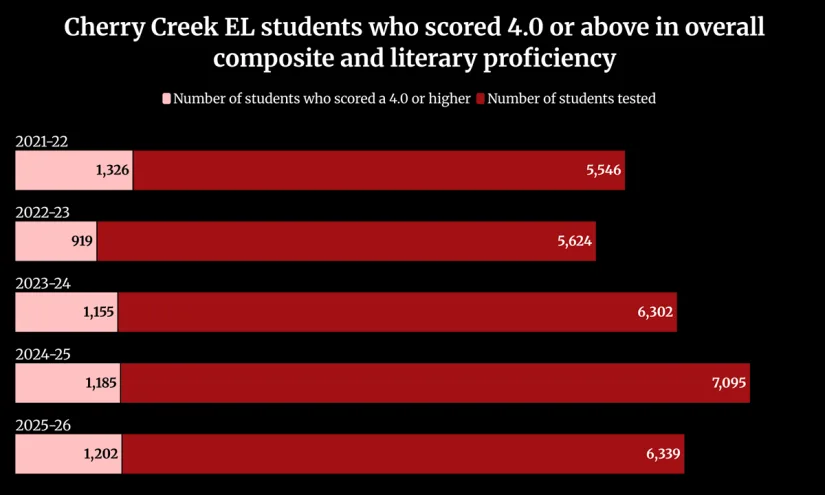
A higher cutoff held back 5,700 students
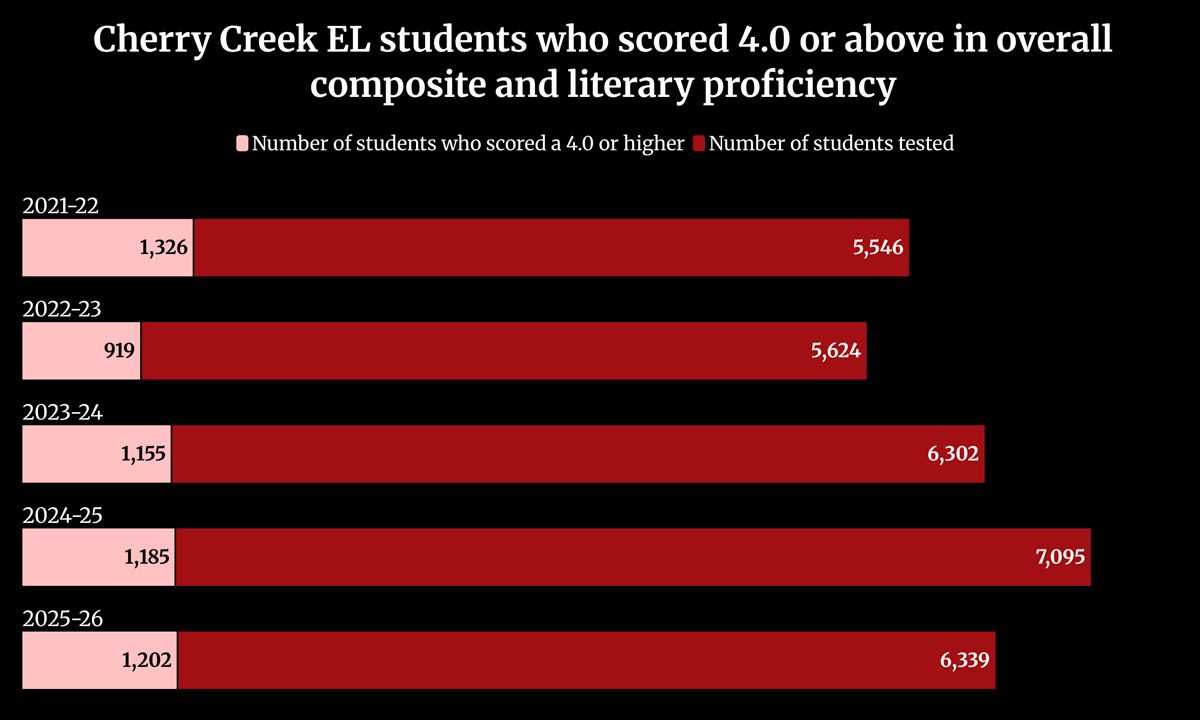
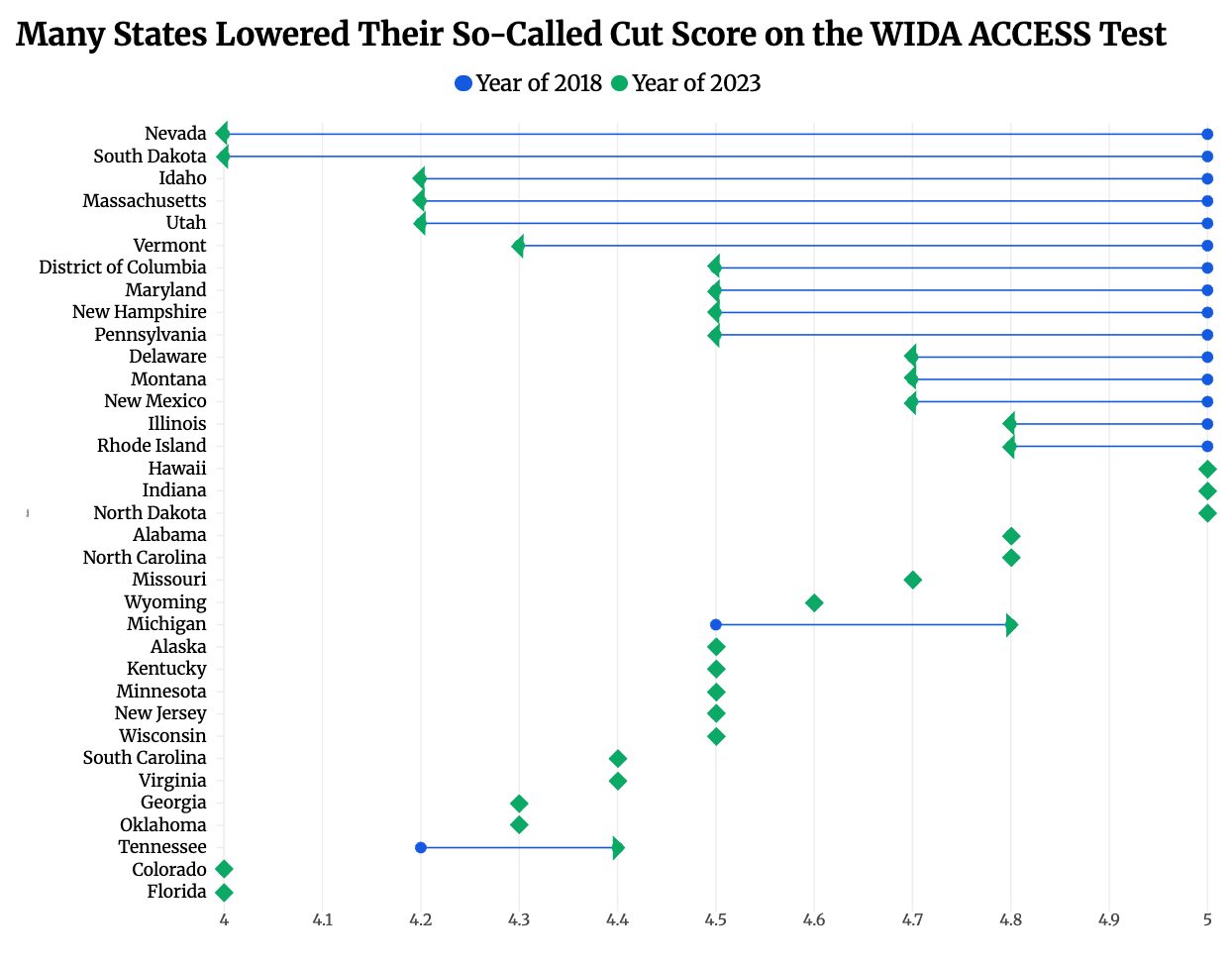
When Jen Hanson took over Cherry Creek's language supports and services in June 2025, she found the district using a 4.5 WIDA ACCESS score as the trigger for evaluating English learners for exit, while Colorado's standard sat at 4.0. Between the 2021-22 and 2025-26 school years, she counted more than 5,700 students who had hit the 4.0 benchmark but were never evaluated. After she changed the criteria back to 4.0, nearly 2,000 students moved into the monitoring phase in September 2025 — the district disputes that number, putting it at 874. The state education department initially told The 74 that 4.0 had always been the standard, then retracted, saying districts had flexibility until the 2026-27 school year, when a higher cutoff was prohibited.
Federal and state funding followed the labels
Federal and state funding followed the labels: Cherry Creek received $3 million in federal Title III money and $10.25 million in state funds over five years to serve its English learner population, which stood at 8,480 students in the 2025-26 school year. The dollars flow based on the number of students classified as English learners, giving the district a financial incentive to keep the count high. After Hanson's changes, a state audit of 17 students in the 2024-25 school year found five — nearly 30% — did not meet funding documentation requirements. The district's spokesperson Abbe Smith said audits were clear and the district had never been flagged as out of compliance. But the audit is not finalized, and the state education department said the five students' files lacked required documentation. The state reviewed 31 districts that year, and Cherry Creek was among them.
Students lost access to advanced courses
Hanson said the prolonged English learner status kept kids out of career and technical education, Advanced Placement courses, and college-level classes. She pointed to her own record at Denver South High School, where as principal she pushed the number of English learners in advanced classes from 73 in 2015 to over 620 in 2018, and they passed with a B average. Cherry Creek officials acknowledged that only about 5% of English learners participate in advanced courses, while 15% of all district students are English learners. They countered that some English learners do take advanced courses and earn college credit, but they admitted the gap is part of their strategic plan to improve proportionality, insisting it is not zero. Jorge Garcia, executive director of The Colorado Association for Bilingual Education, called it a civil rights and human rights issue, saying holding students back kills their spirit to achieve. Hanson added, 'Kids know when you don't believe in them.'

Hanson says she was fired for fixing the problem
Hanson's reclassification of nearly 2,000 English learners in September 2025 was initially celebrated with certificates. But eight months later, on May 29, 2026, Cherry Creek emailed her to say her contract would not be renewed, while she was out on medical leave. She had just been called into human resources and told she had too many absences and needed to stop complaining. The non-renewal came after a leadership shakeup in early 2026, when several top administrators left, and against a backdrop of other controversies: the former superintendent resigned in January and the HR chief was fired in May after an investigation. Hanson had detailed her concerns in a March 11 email to her new supervisor Michelle Weinraub, which she shared with The 74. She filed a retaliation complaint with the Equal Employment Opportunity Commission on July 20, saying, 'I want the district to be held accountable and stop doing this to kids.'
Colorado's guidance changed — but did it?
The state's own position wavered. In late July, a department spokesman wrote that districts 'are not permitted to raise the statewide exit criteria' and that 4.0 had always been the standard. Days later, the department retracted, saying districts did have leeway in past years and that the guidance had evolved from 'should' to 'must consider' starting in 2022-23. It then admitted that its distribution lists did not reach all staff, and apologized for the delay in correcting the record. For the 2026-27 school year, the state finally prohibited using a higher standard. Cherry Creek officials said they never exercised discretion and always used 4.0, but Hanson said the district set a 4.5 threshold for evaluation, and she identified 283 students who had scored 4.5 on both critical parts of the WIDA test and remained in the program years later.
Texas research: reclassification helps access but hurts grades
In a July study in Educational Evaluation and Policy Analysis, Shirley Xu of Vanderbilt University and her team examined Texas students who reclassified in 8th grade versus those who entered high school still labeled as English learners. They found that reclassified students gained better access to advanced courses like IB and AP, but their academic performance dipped, especially in math, and they were less likely to graduate on time. Xu, a former ESL teacher, also noted that many students who retained the label had high language proficiency but low academic test scores. The study's comparison between the two groups — one with the label, one without — shows that the extra supports attached to the English learner designation can matter for academic outcomes even when a student's oral and written English appear strong. For districts, the findings underline the importance of looking beyond language proficiency alone when deciding whether a student is ready to exit.
State audit flags funding documentation problems
Colorado's 2024-25 audit of Cherry Creek examined 17 English learners and found that five — nearly 30% — did not meet the requirements to receive state and federal funding based on the documentation the district provided. The audit is one of 31 districts reviewed for English learner documentation and is not yet finalized, according to Jeremy Meyer, a state department spokesman. The district had previously cited its clean audits as proof of compliance, with spokesperson Abbe Smith saying, "Our audits from (the state education department) are clear. It has not been flagged at any point that Cherry Creek is a concern or massively out of compliance." But the preliminary finding contradicts that claim. The audit's focus on documentation suggests that the district's recordkeeping — not necessarily the students' proficiency — was the issue. State funding for English learners flows based on the number of students classified as such, so documentation errors could mean the district received money for students who no longer qualified. The final audit could further clarify the scope of the problem.
Former staffer: Test score data was kept from educators
A former Cherry Creek staffer, who worked as a professional learning partner across the district office and at 25 schools, told The 74 that teachers were denied access to individual English learners' test scores. She said the data was "near impossible to pull," and when she asked to see students' marks, she was scolded by superiors with "How dare you ask that. That is not your business." The woman, who asked not to be identified for fear of retaliation, had previously worked at a neighboring district where Cherry Creek students sometimes transferred. She said that district was often stunned to learn the students were still receiving English language services given how well they scored on proficiency exams. "There are kids who get put in these classes who never get the chance to leave," she said. She also believed the district's former director, Holly Porter, held ideas about multilingual learning that were not backed by current research or best practices. The lack of access to test scores meant teachers could not tailor instruction to students' actual needs, potentially keeping them in the program longer than necessary.
Keep reading

Teaching
Dyscalculia is as common as dyslexia—but most districts can't spot it
A national scan finds up to 60% of affected students also have ADHD or dyslexia, yet only 1 in 5 teachers feel prepared, seven states lead on policy, and few districts have the specialists or referral systems to intervene.