McMahon's Year-End Ultimatum: How Colleges Must Act to Stem Trust Crisis
Education Secretary Linda McMahon demands public commitments to policy reforms by December as public confidence in higher education hits record lows.
By Brainova
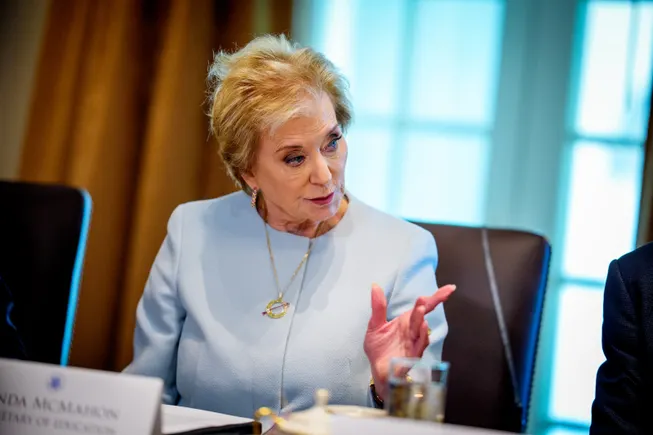
What specific reforms is Secretary McMahon urging colleges to adopt?
Secretary Linda McMahon’s Aug. 3 'National Call to Action' urges colleges to post detailed policy commitments on their websites by the end of the year. These commitments span adopting clear admissions criteria, hiring faculty with diverse perspectives, managing disruptive protests, containing costs, fighting grade inflation, meeting workforce needs, addressing artificial intelligence, encouraging diversity of thought, and ensuring programs are free from foreign influence. McMahon poses specific questions for institutions to answer, such as how they will balance free speech with safety during campus protests and how they will keep tuition affordable while maintaining academic rigor. This public disclosure mechanism is designed to ensure transparency, allowing students, families, and policymakers to assess each college’s plans. The department expects these statements to be prominently displayed, moving from vague promises to measurable actions that address the sector’s trust deficit.
Why is this initiative launching now?
The initiative launches amid a sharp decline in public trust in higher education. A recent Lumina Foundation and Gallup poll found that only 38% of surveyed adults have high confidence in the sector, a drop from previous years and just above the record low of 36% in 2023 and 2024. This erosion is driven by multiple factors: about a third of respondents with low confidence cite perceived political agendas on campus and high college costs, while 8% point to interference from the Trump administration. Democrats have contributed to the recent decline, though Republicans remain less confident overall. McMahon’s letter, resulting from months of meetings with college leaders as noted by Deputy Chief of Staff Jonathan Pidluzny, directly addresses this crisis. The call to action is a response to data showing widespread skepticism, urging reforms to restore credibility.
What is the deadline, and what happens if colleges don't respond?
Colleges have until the end of 2024 to publicly detail their reform plans on their websites. While there are no 'direct penalties' for non-compliance, as stated by Deputy Chief of Staff Jonathan Pidluzny, silence could have indirect consequences. Pidluzny cautioned that universities refusing to engage in good faith will find that 'silence will speak volumes,' potentially affecting their reputation and future federal interactions. The deadline is intended to spur immediate action during the fall academic term, prompting institutions to assess and commit to changes. This voluntary approach allows colleges flexibility in addressing issues relevant to their missions, but the department emphasizes the importance of public accountability. Readers can monitor college websites to see which institutions respond and how their commitments align with the outlined reforms.
How does this compare to the Trump administration's compact with nine colleges?
McMahon’s letter echoes themes from a compact shared last year with nine colleges, which offered priority for federal research funding in exchange for sweeping policy changes like requiring all undergraduates to submit standardized test scores and freezing tuition for five years. Most institutions rejected that compact, citing threats to institutional independence and autonomy. In contrast, McMahon’s call is a separate effort that asks colleges to answer open-ended questions rather than make rigid commitments. This shift aims for broader relevance across different types of institutions; as Pidluzny explained, issues like merit-based admissions are urgent at some schools but not all. The new approach reduces one-size-fits-all pressure, allowing colleges to tailor reforms to their contexts. Pidluzny stated that merit-based admissions are an urgent problem at some institutions but not every university.
What examples has McMahon cited of colleges already taking action?
McMahon pointed to specific examples of colleges already taking action. At Yale University, a committee report attributed declining trust to unclear admissions policies, grade inflation, and concerns about free speech on campus. She also highlighted a report on humanities scholarship commissioned by leaders of Vanderbilt University and Washington University in Saint Louis, which found signs of 'deterioration in scholarly standards fueled by the substitution of political criteria' for scholarly criteria. This report drew criticism from Inside Higher Ed for not going far enough in its recommendations. Additionally, McMahon praised colleges that have adopted institutional neutrality, where officials refrain from commenting on political matters unrelated to their mission, though she did not name those institutions. These examples serve as models for how institutions can self-assess and initiate reforms aligned with the call to action.