Why 'McDonald's' Becomes Five Syllables: The Hidden Rules of Japan's Loanword Machine
A deep dive into katakanization—the three phonological rules that transform English into Japanese, and why your perfectly pronounced American English might leave Tokyo baristas staring blankly.
By Brainova
The Native Speaker's Irony
My wife, a native English speaker who has lived in Japan for 15 years and speaks fluent Japanese, still fumbles one word above all others: McDonald's. In Japanese, it's pronounced makudonarudo — a five-syllable mouthful that barely resembles the American original. She knows this. She orders with confidence. But the muscle memory of her childhood phonology fights the Japanese system every time.
It's a quirk that should be encouraging to learners, not discouraging. The Japanese phonological universe operates on a simple truth: it does not allow syllables to end in a consonant (except for /n/). English is full of words like cat, look, and ship that are simply unpronounceable in Japanese as-is. So when Japanese speakers adapt a foreign word, they're not being sloppy. They're enforcing their language's own strict sound rules — just as English enforces its own on French loanwords, or French's guttural /r/ gets mangled by English speakers.
The result: there's no way to be faithful to both languages. Even at a high level of fluency, your native phonological system — the sound rules you've followed since childhood — will clash with Japanese. Rather than fighting it, learning katakanization means learning to switch systems deliberately.

Rule One: The Vowel Injector
Japanese phonology demands a vowel after almost every consonant. When an English word contains a consonant with no vowel following it, Japanese inserts one. The question is which vowel to choose — and there are rules within the rule.
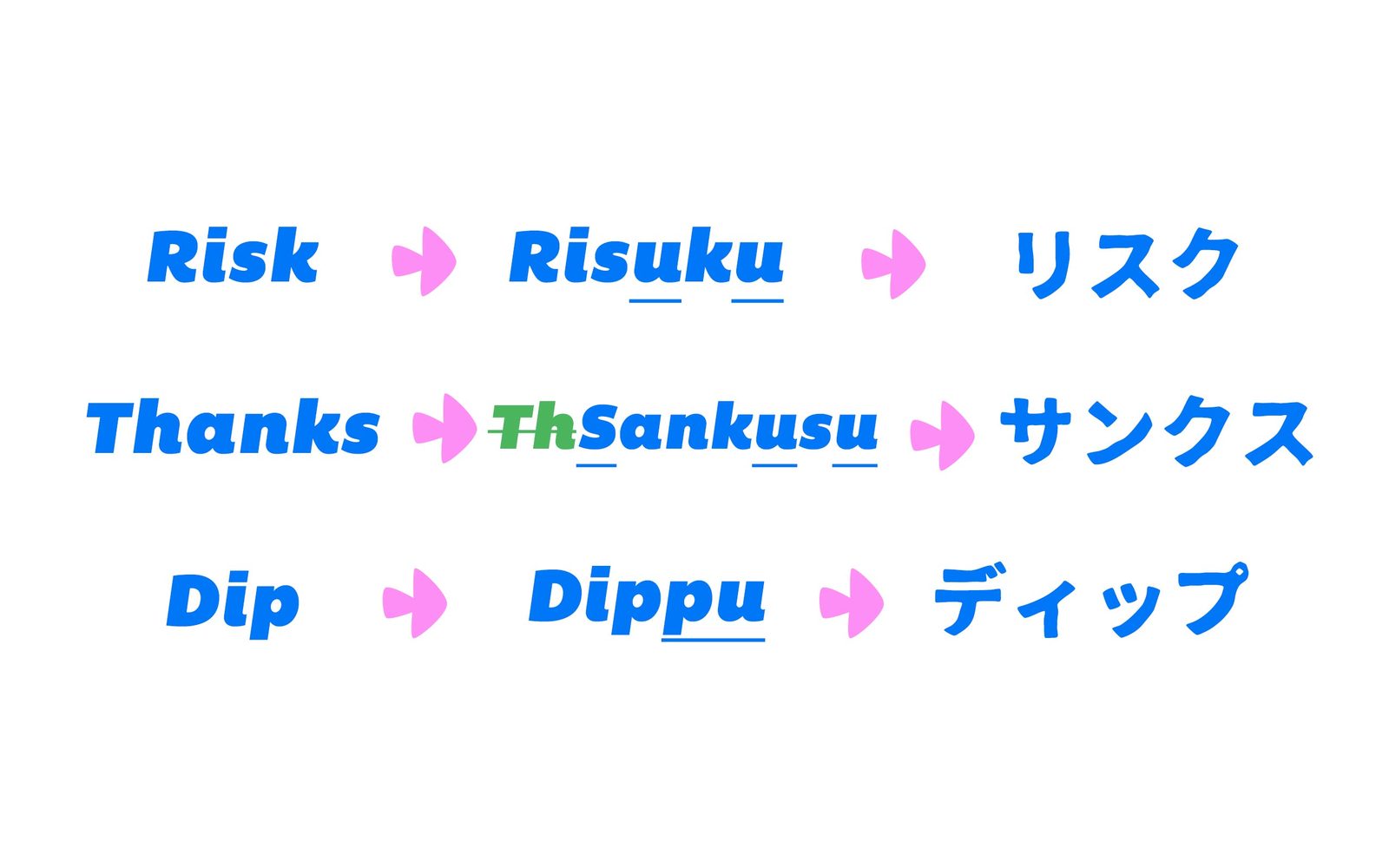
For the word risk, the r and i form a naturally pronounceable pair in Japanese, but s and k are stranded. Both get a u attached, producing risuku (リスク). But if the consonant in question is a t or d, it's an o that gets added. If it's ch or j, it's an i. And if it's n or r, it gets nothing — those can stand alone.
This produces the famous example of size, which sounds like "saiz" in American English, not "see-ze." Only the final z needs a vowel, giving you saizu (サイズ). The trap for English speakers is looking at spelling instead of sound. Your brain sees "size" and thinks si-ze; the Japanese system hears "saiz" and writes saizu.
The system is thoroughly consistent once you know it. But it works only if you're analyzing pronunciation, not spelling — which forces native English speakers to slow down and actually hear their own words.
Rule Two: The Sound Replacement Network
Japanese has only five vowel sounds — ア, イ, ウ, エ, オ — while English has at least a dozen. This means a single Japanese character must serve multiple English sounds. The /æ/ in hat and the /ʌ/ in hut are distinct in English, but both turn into ハット in Japanese.
This compression hits hardest on consonants. The English /v/ sound doesn't exist in Japanese, so it's replaced with /b/. The /l/ and /r/ distinction — a famous trouble spot for Japanese speakers learning English — works in reverse: both lease and wreath become リース. The word belly, berry, and very all become ベリー in Japanese. If you're ordering a berry and accidentally say "belly," a Japanese speaker hears the same word anyway.
Even more confusingly, English si and shi both collapse into シ, so sea and she become homophones. And zi and ji collapse into ジ. The th sound — /θ/ — gets replaced by /s/, so three becomes surii, and thanks becomes sankyū.
Rather than being disappointed by this flattening, learners should recognize it as a head start: every English word you know has a Japanese version that's one phonological step away.
Rule Three: The Twenty-First Century's Unsung Hero
Japanese, with its strict syllable structure, lacks the ability to represent compound consonants. But a special set of combination katakana has evolved to handle this gap. These are characters that pair a standard katakana with a small-char suffix — フォ (fo), ティ (ti), ジュ (ju), even the obscure トゥ (tu).
This is how cat becomes kyatto (キャット) rather than the logical katto (カット). And gap becomes gyappu (ギャップ), not gappu (ガップ). The vowel sound in the English word changes which Japanese pair is closest.
These combination characters are particularly common in modern loanword adaptation, which has shifted toward favoring fidelity to the original sound rather than ease of pronunciation for Japanese speakers. That's a reversal from older loanword habits. The word idea, for instance, used to be written aidea (アイデア) but is now more commonly aidia (アイディア) — reflecting a stricter attempt to capture the English pronunciation.
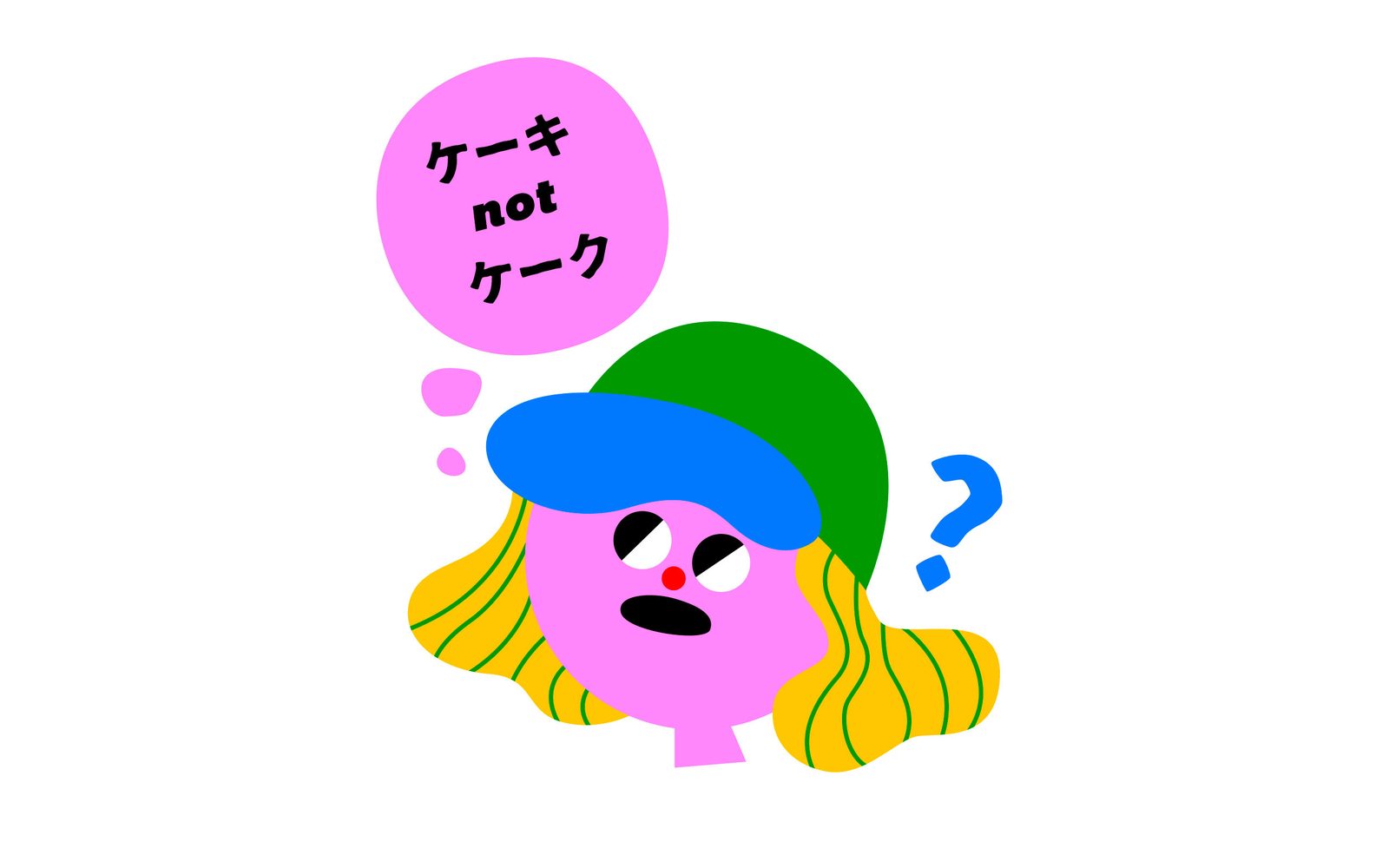
Watch out for older loanwords like kēki (ケーキ) for cake or rajio (ラジオ) for radio, which don't follow the modern rules at all. They were borrowed before the conversion system stabilized. You'll have to memorize those separately — the same way you memorize any irregular verb in your native language.
The 3,000-to-5,000 Word Head Start
The practical payoff for mastering katakanization is enormous. Japanese speakers use between 3,000 and 5,000 loanwords in everyday conversation, and 94% of those are English-derived. In the 1990s, over 35% of all vocabulary printed in 70 Japanese magazines was foreign loanwords, mostly English. That share has likely grown with the influx of new technology concepts like appurikēshon (アプリケーション) and ikoon (アイコン).
When you recognize that the Japanese term for installing follows the same rules as the Japanese term for application, your vocabulary instantly multiplies — and you start understanding Japanese technology manuals without a dictionary.
This makes learning katakanization a game-changer. It's not just a pronunciation workaround; it's an etymological shortcut to understanding hundreds of Japanese words you've never explicitly studied.
Keep reading
Languages
Three Scripts, One Language: How Japan's Writing System Really Works
A guide to the origins, differences, and practical uses of hiragana, katakana, and kanji for learners.

Languages
How to Learn Hiragana and Katakana Without Hours of Copywork
Mnemonics and reading-first practice turn 92 unfamiliar shapes into a two-week win.

Languages
8 French Slang Words That Separate Locals from Tourists in Paris
Kiffer, meuf, pote, blindé, bosser, mec, bouffe, crevé — the everyday vocabulary that tells Parisians you live here, not just visit.